The problem
Portable tools are individually good and collectively bad. A travelling engineer's kit is a pocket supply, a USB meter, a smart iron, a fan and a small scope. Each one has its own charger, screen, battery, firmware and idea of what "small" means. Packed together they leave a case half empty. None of them can trigger or timestamp another, and none of them can be scripted.
The missing piece isn't another small instrument. It's a shared mechanical, electrical and protocol standard that lets small instruments, and small hand tools, fit together into one system that travels, describes itself, and that anyone can extend.
How it works
- One footprint. Every module is 84 × 84 mm on the Gridfinity 42 mm grid, and long hand-tool trays are 210 × 84 mm. The whole kit also drops into a Gridfinity drawer back at the bench.
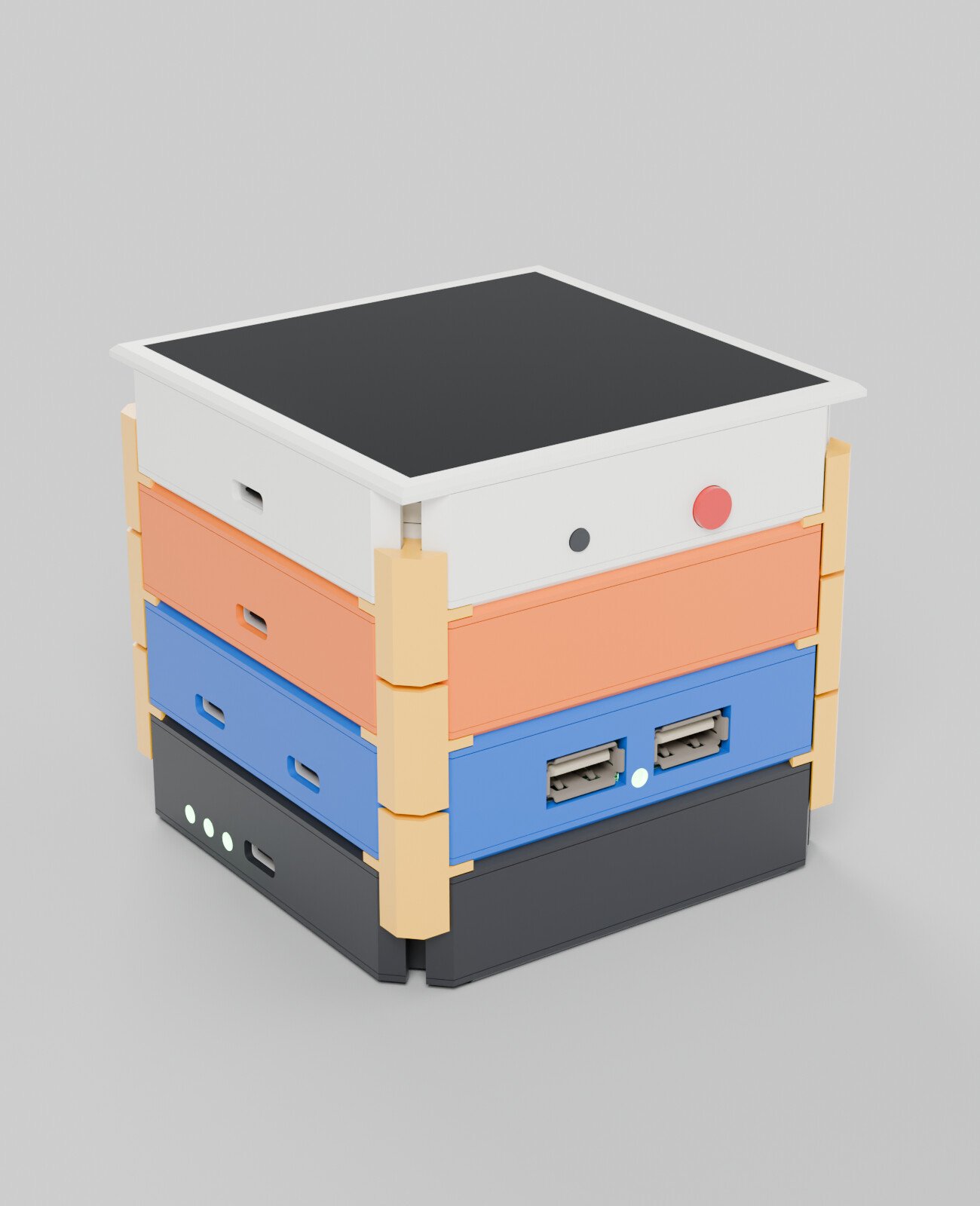
- Corner T-slots and keys. Four 45° corners take a sliding key, so any module can be clipped to any other, side by side or on top.
- A live tower. Stacked vertically, modules connect through a 20-contact pogo joint. They share a 20 V power rail, a CAN-FD control bus and one trigger line. Side coupling is only mechanical, and no contact is live in transit.
- Position is the address. Each module learns its place in the tower from where it sits, then publishes a description of what it can do. The touchscreen and the host API are generated from those descriptions, so adding a module means changing no other firmware.
- Works alone. Every active module also runs on its own USB-C, without the tower.
The first kit
Four modules, chosen as the smallest set that tests the whole architecture: power in, battery, bus, a real instrument, and a user interface.
- Power hub - a USB-PD input up to 100 W feeding the 20 V bus, with four switched and metered USB-C ports, two USB-A and a micro-SD reader. On its own it is a USB power hub.
- Battery base - 38 Wh (3S 18650), under the airline carry-on limit. On its own it is a USB-C power bank.
- Meter - a multimeter and LCR meter with an isolated front end. On its own it streams readings to a laptop or phone.
- Interface - a 3.4" 480 × 480 touchscreen at the top of the stack. It runs the bus and draws its UI from the modules' descriptions.
The schematics for all four are complete and pin-checked, and each one shares a common core sheet: USB-C PD, the power OR with the bus, the MCU, CAN-FD and the descriptor. The enclosures are parametric FreeCAD models, and the board outlines are generated from the CAD so the two cannot drift apart. Electronics for one kit come to about €270 at ten kits.
Where it sits
CleverTool is the field bench for CleverHand: planned bridge modules will power and enumerate a CleverHand chain and serve as its portable programming and test jig. It is also meant for anyone who does real engineering away from their bench, so the first target is freelance engineers and makers.
Open by design
Hardware under CERN-OHL-S, software under Apache-2.0, documentation under CC-BY-4.0. The standard matters more than any one module: third-party modules are meant to be first-class.
Status
In design. The four first-kit modules are drafted in CAD and KiCad, with the enclosures and joint rendered. Next come printed dummies to settle key and slot tolerances by hand, then a pogo-joint test fixture and the first boards.